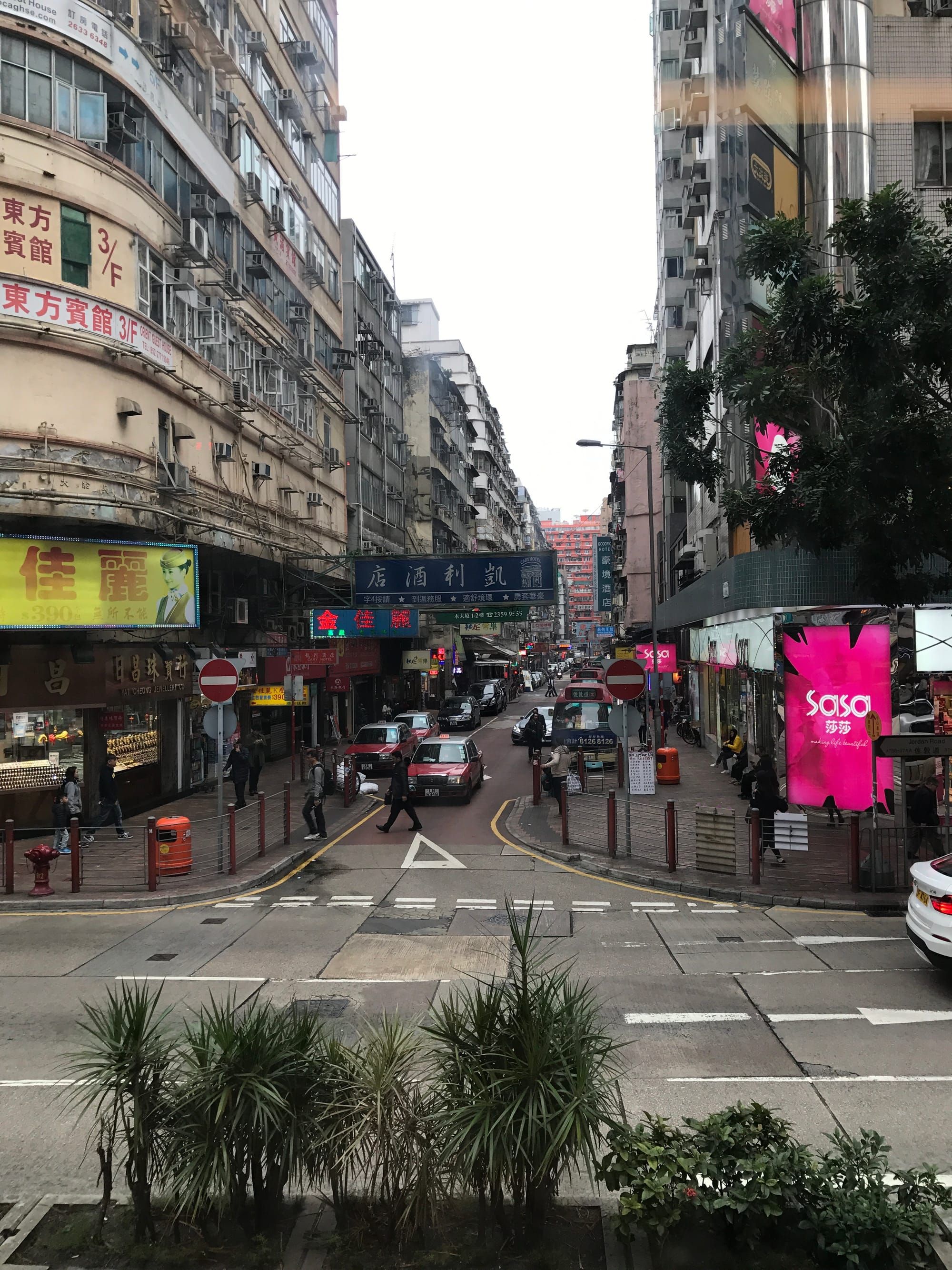
There are cities you visit. And then there are cities that decide you're coming back.
Hong Kong has been a constant across different chapters of our lives. We've lost count of the trips, and yet every time, the city has something new to show us.
Stepping off the plane in January, the feeling wasn't arrival — it was return.
The pace hits first: the purposeful crowd, the layered skyline, the sense that something is always happening just around the next corner. Fast, dense, and completely alive. It feels like a second home in the way that only a handful of cities ever do.
We don't plan cities down to the hour. The best ones don't reward it. Hong Kong is one of them.
This trip, we did it differently — three days in Hong Kong, then across the border into Shenzhen, then back for three more. One trip across Southeast Asia, with The Langham in Tsim Sha Tsui anchoring both of our stays. Sitting in the heart of TST, it's as well positioned as a hotel in the city can be — the harbour, the MTR, the best bars and restaurants all within easy reach. It became our base, and a very good one at that.
Coming back to the same room after Shenzhen made the return feel less like a check-in and more like coming home.
This was the opening chapter of a longer January journey — the three of us: Vannessa, Avery, and I — working our way through Southeast Asia. But Hong Kong was always the place we kept coming back to, literally and in every other sense.
What Hong Kong does better than almost anywhere — and better than most cities will ever manage — is neighbourhoods. Each one has its own tempo, its own character, its own reason to linger. We didn't try to plan it — we walked, followed instinct, and let the city decide what mattered. Getting around is half the experience.
The MTR is the backbone — clean, efficient, fast, the kind of system that actually opens a city up. Early or late, it doesn't matter. It will get you there.
On one of our first trips, visiting a friend who had made Hong Kong home, the three of us had one too many drinks — the kind of night you don't forget. Somehow, despite being in no condition to navigate anything, I managed to get us all home without incident.
The next morning was rough. The journey home wasn't.
For something slower and more scenic, the Star Ferry is the move. The crossing between Kowloon and Hong Kong Island is one of the great five-minute journeys in travel — and at night, from the lower deck, the skyline opens up in front of you in a way no photograph quite captures.
What makes it special isn't just the view. It's that the experience hasn't changed. The same crossing, the same green and white boats, the same harbour air — what you feel stepping onto that lower deck today isn't so different from what passengers felt decades ago. In a city that never stops reinventing itself, the Star Ferry is a rare constant.
Above street level, the ding ding — Hong Kong's iconic double-decker tram — offers something different again. Unhurried, nostalgic, completely its own thing. Sitting up top gives you a vantage of the city no MTR ever could. The double-decker buses offer the same perspective with a bit more speed. Both are worth your time.
Then there's the taxi. Not just any taxi — the Toyota Crown Comfort.
It's more than a car. It's part of the city.
Hong Kong's version of the Ford Crown Victoria — instantly recognisable, completely irreplaceable, and slowly being phased out.
Ride in one while you still can. It is not optional.
We made sure we had cash set aside just for this — we weren't leaving without putting Avery in a Crown Comfort.
That's how seriously we take it.
This time, the experience delivered something beyond the expected. The car sounded like it was working through something personal — and losing. He drove his automatic like a man who learned on a manual and never quite let go. He himself was pure Hong Kong — attitude, style, completely unbothered.
The car, the driver, the journey — none of it should have worked. All of it did.
We weren't sure we'd make it — but you don't bet against a man and his Crown. Not in Hong Kong.
The minibuses are their own category entirely — faster than they have any right to be, routes that feel improvised, drivers who treat the streets as a personal challenge. Not for the faint of heart, but as Hong Kong as anything else on this list.
Mornings in Hong Kong have their own rhythm. Find a cha chaan teng — somewhere between a diner and a canteen — and order milk tea, eggs, and toast before the day takes over. It's not about slowing down. It's about getting moving.
After a full day on your feet — and you will walk more than you expect — we stopped at Australian Dairy Company. We'd heard good things. What we found was better: classic Hong Kong food, no fuss, direct service, and the kind of meal that earns its queue without explanation.
Don't overthink it. Just go.
What separates Hong Kong from cities like Vancouver isn't just density or pace — it's what happens after work. People don't disappear home. The city opens up.
Bars, streets, dai pai dongs and rooftop bars — everything becomes part of the same energy. It's addictive — and the city knows it.
The crowd is global — every corner of the world represented, alongside people who grew up in Hong Kong itself. Tokyo, Singapore, London, Vancouver, Sydney, New York — everyone passes through eventually. Hong Kong sits at the centre of Asia in a way that makes it a natural gathering point, and that proximity collapses distances in a way that makes the world feel smaller than it has any right to.
Few cities make it easier to reconnect with someone you haven't seen in years, or meet someone new as if you've known them forever.
That's the thing about Hong Kong — it keeps delivering the right people at the right moment.
Starting a conversation felt easy. Run into someone from Vancouver — even a stranger — and within minutes it feels like you've known each other for years.
That openness is part of what keeps pulling us back.
And if you happen to be there on a Wednesday night, there's only one place to be — Happy Valley Racecourse. Floodlit, loud, and electric, it's one of Hong Kong's great open secrets.
It deserves its own story. We're working on it.
Some of our best nights unfolded without any plan at all. We'd meet up with friends, start walking, and let the city take over.
One night we wandered into a karaoke bar — the kind of place you don't look for, you end up in — ordered drinks, grabbed the mic, and fully committed.
Most of the people we ended up with were from Vancouver, introduced just hours earlier but already feeling like old friends. That kind of instant familiarity only seems to happen when you're far from home and the city keeps throwing the right people your way.
We found ourselves in one of Central's more colourful corners. The crowd adopted us immediately.
The singing was terrible. No one cared.
Looking back, that's Hong Kong — you let go, and the city takes care of the rest.
But the nights weren't the only surprise.
At The Langham, we took a cocktail-making class with Randall, the hotel's bartender. Each of us came in with a different idea — gin cocktails, the perfect martini, something involving peanut butter.
He walked us through all of it — not just how to make the drinks, but why they worked.
It changed how we looked at every bar after.
If you're staying there, take the class. Don't overthink it.
That same night, after karaoke, we ended up at Holy Eats — not by plan, but because someone in the group knew the way. Tucked into the hills of Central, just off the main drag. What made it even stranger and better was that we'd been there before — years earlier, brought by someone completely different who also happened to know the owner. Different trip, different people, same bar, same welcome.
Some places just find you.
Hong Kong's cocktail scene deserves its own conversation — and it's getting one. The bars we found are some of the best in Asia, each completely different from the last.
That guide is coming.
January is one of the best times to visit. After the holidays and before Chinese New Year's Golden Week, the city settles into a rhythm — warm, clear, and easy to explore. A world away from Vancouver in winter.
The city doesn't slow down for the weather — it doesn't slow down for anything — but it's easier to explore before the humidity arrives. Easier to walk. Easier to linger. Easier to say yes to one more bar.
Three to five days is enough to understand it.
But don't underestimate what even a layover can deliver.
On his way home, Avery had one final stop in Hong Kong. By then, Vannessa and I had already made our way back from Singapore — a city that deserves its own story, and will get one.
He knew exactly how many hours he had — and exactly where he was going.
He made it to Bar Leone, had a cocktail, and came back with what they claim are the world's greatest olives.
We can't argue.
They are.
Hong Kong is that accessible.
Pick up an Octopus card at the MTR station when you arrive. It makes everything easier. Cash is still king in Hong Kong — carry some. Cards are accepted in most hotels and larger restaurants, but smaller establishments, street food stalls, taxis, and markets will expect it. English is widely spoken, getting around is straightforward, and we never once felt unsafe.
Hong Kong is one of the easiest cities in the world to navigate — which makes the depth it offers even more surprising.
And if you find yourself with a free afternoon and a sense of adventure, Shenzhen is fifteen minutes away by train — and a story we'll be telling soon.
You'll come back.
That's the thing about Hong Kong.
It doesn't let go.